
easyclimate.core.stats.yearstat
This module calculates statistical values over timesteps of the same year
Functions
|
Calculate yearly mean. |
|
Calculate yearly sum. |
|
Calculate yearly standard deviation. |
|
Calculate yearly standard deviation. |
|
Calculate yearly standard deviation. |
|
Calculate yearly standard deviation. |
Module Contents
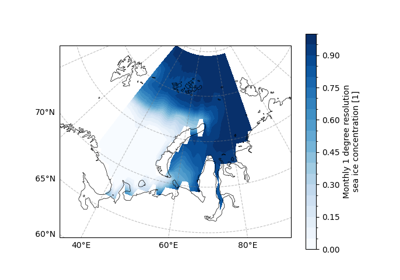
- easyclimate.core.stats.yearstat.calc_yearly_mean(data_input: xarray.DataArray, dim: str = 'time', **kwargs)
Calculate yearly mean.
For every adjacent sequence \(t_1, ..., t_n\) of timesteps of the same year it is:
\[o(t, x) = \mathrm{mean} \left \lbrace i(t', x), t_1 < t' \leqslant t_n \right\rbrace\]Tip
This function uses
xarray.DataArray.groupbyto implement the calculation. To substantially improve the performance of GroupBy operations, particularly with dask install the flox package. flox extends Xarray’s in-built GroupBy capabilities by allowing grouping by multiple variables, and lazy grouping by dask arrays. If installed, Xarray will automatically use flox by default.Parameters
- data_input:
xarray.DataArray. xarray.DataArrayto be calculated.Note
The recommended frequence of the data_input is monthly.
- dim:
str Dimension(s) over which to apply extracting. By default extracting is applied over the time dimension.
- **kwargs:
Additional keyword arguments passed on to the appropriate array function for calculating mean on this object’s data. These could include dask-specific kwargs like split_every.
Returns
xarray.DataArraywith time dimension type ofnumpy.datetime64.See also
numpy.mean,dask.array.mean,xarray.DataArray.mean,xarray.core.groupby.DataArrayGroupBy.mean.- data_input:
- easyclimate.core.stats.yearstat.calc_yearly_sum(data_input: xarray.DataArray, dim: str = 'time', **kwargs)
Calculate yearly sum.
For every adjacent sequence \(t_1, ..., t_n\) of timesteps of the same year it is:
\[o(t, x) = \mathrm{sum} \left \lbrace i(t', x), t_1 < t' \leqslant t_n \right\rbrace\]Tip
This function uses
xarray.DataArray.groupbyto implement the calculation. To substantially improve the performance of GroupBy operations, particularly with dask install the flox package. flox extends Xarray’s in-built GroupBy capabilities by allowing grouping by multiple variables, and lazy grouping by dask arrays. If installed, Xarray will automatically use flox by default.Parameters
- data_input:
xarray.DataArray. xarray.DataArrayto be calculated.Note
The recommended frequence of the data_input is monthly.
- dim:
str Dimension(s) over which to apply extracting. By default extracting is applied over the time dimension.
- **kwargs:
Additional keyword arguments passed on to the appropriate array function for calculating sum on this object’s data. These could include dask-specific kwargs like split_every.
Returns
xarray.DataArraywith time dimension type ofnumpy.datetime64.- data_input:
- easyclimate.core.stats.yearstat.calc_yearly_std(data_input: xarray.DataArray, dim: str = 'time', **kwargs)
Calculate yearly standard deviation.
For every adjacent sequence \(t_1, ..., t_n\) of timesteps of the same year it is:
\[o(t, x) = \mathrm{std} \left \lbrace i(t', x), t_1 < t' \leqslant t_n \right\rbrace\]Tip
This function uses
xarray.DataArray.groupbyto implement the calculation. To substantially improve the performance of GroupBy operations, particularly with dask install the flox package. flox extends Xarray’s in-built GroupBy capabilities by allowing grouping by multiple variables, and lazy grouping by dask arrays. If installed, Xarray will automatically use flox by default.Parameters
- data_input:
xarray.DataArray. xarray.DataArrayto be calculated.Note
The recommended frequence of the data_input is monthly.
- dim:
str Dimension(s) over which to apply extracting. By default extracting is applied over the time dimension.
- **kwargs:
Additional keyword arguments passed on to the appropriate array function for calculating std on this object’s data. These could include dask-specific kwargs like split_every.
Note
The parameter ddof is Delta Degrees of Freedom: the divisor used in the calculation is N - ddof, where N represents the number of elements. If the data needs to be Normalize by (n-1), then ddof=1.
Returns
xarray.DataArraywith time dimension type ofnumpy.datetime64.- data_input:
- easyclimate.core.stats.yearstat.calc_yearly_var(data_input: xarray.DataArray, dim: str = 'time', **kwargs)
Calculate yearly standard deviation.
For every adjacent sequence \(t_1, ..., t_n\) of timesteps of the same year it is:
\[o(t, x) = \mathrm{var} \left \lbrace i(t', x), t_1 < t' \leqslant t_n \right\rbrace\]Tip
This function uses
xarray.DataArray.groupbyto implement the calculation. To substantially improve the performance of GroupBy operations, particularly with dask install the flox package. flox extends Xarray’s in-built GroupBy capabilities by allowing grouping by multiple variables, and lazy grouping by dask arrays. If installed, Xarray will automatically use flox by default.Parameters
- data_input:
xarray.DataArray. xarray.DataArrayto be calculated.Note
The recommended frequence of the data_input is monthly.
- dim:
str Dimension(s) over which to apply extracting. By default extracting is applied over the time dimension.
- **kwargs:
Additional keyword arguments passed on to the appropriate array function for calculating var on this object’s data. These could include dask-specific kwargs like split_every.
Note
The parameter ddof is Delta Degrees of Freedom: the divisor used in the calculation is N - ddof, where N represents the number of elements. If the data needs to be Normalize by (n-1), then ddof=1.
Returns
xarray.DataArraywith time dimension type ofnumpy.datetime64.- data_input:
- easyclimate.core.stats.yearstat.calc_yearly_max(data_input: xarray.DataArray, dim: str = 'time', **kwargs)
Calculate yearly standard deviation.
For every adjacent sequence \(t_1, ..., t_n\) of timesteps of the same year it is:
\[o(t, x) = \mathrm{max} \left \lbrace i(t', x), t_1 < t' \leqslant t_n \right\rbrace\]Tip
This function uses
xarray.DataArray.groupbyto implement the calculation. To substantially improve the performance of GroupBy operations, particularly with dask install the flox package. flox extends Xarray’s in-built GroupBy capabilities by allowing grouping by multiple variables, and lazy grouping by dask arrays. If installed, Xarray will automatically use flox by default.Parameters
- data_input:
xarray.DataArray. xarray.DataArrayto be calculated.Note
The recommended frequence of the data_input is monthly.
- dim:
str Dimension(s) over which to apply extracting. By default extracting is applied over the time dimension.
- **kwargs:
Additional keyword arguments passed on to the appropriate array function for calculating max on this object’s data. These could include dask-specific kwargs like split_every.
Returns
xarray.DataArraywith time dimension type ofnumpy.datetime64.See also
numpy.maximum,dask.array.max,xarray.DataArray.max,xarray.core.groupby.DataArrayGroupBy.max.- data_input:
- easyclimate.core.stats.yearstat.calc_yearly_min(data_input: xarray.DataArray, dim: str = 'time', **kwargs)
Calculate yearly standard deviation.
For every adjacent sequence \(t_1, ..., t_n\) of timesteps of the same year it is:
\[o(t, x) = \mathrm{min} \left \lbrace i(t', x), t_1 < t' \leqslant t_n \right\rbrace\]Tip
This function uses
xarray.DataArray.groupbyto implement the calculation. To substantially improve the performance of GroupBy operations, particularly with dask install the flox package. flox extends Xarray’s in-built GroupBy capabilities by allowing grouping by multiple variables, and lazy grouping by dask arrays. If installed, Xarray will automatically use flox by default.Parameters
- data_input:
xarray.DataArray. xarray.DataArrayto be calculated.Note
The recommended frequence of the data_input is monthly.
- dim:
str Dimension(s) over which to apply extracting. By default extracting is applied over the time dimension.
- **kwargs:
Additional keyword arguments passed on to the appropriate array function for calculating min on this object’s data. These could include dask-specific kwargs like split_every.
Returns
xarray.DataArraywith time dimension type ofnumpy.datetime64.See also
numpy.minimum,dask.array.min,xarray.DataArray.min,xarray.core.groupby.DataArrayGroupBy.min.- data_input: